Skip to content

Product

A record you can hand to somebody who is paid to disagree with you.

Reliable Context keeps one canonical record per real thing and attaches, to every value on it, the sentence it was read from, where that sentence was, the day it was read, and what it was carried in preference to. What follows is that record as a reader meets it, and the properties they can check on any line of it without asking us anything.

Unit
One record per real thing, one identifier for its lifetime.
Admission
A verbatim excerpt, a locator and two dates, or the value is not carried.
Absence
A named negative with its reason. Never an empty cell.
History
Append-only. Any past state can be read again as it stood.
Boundary
Your infrastructure, one database for your organization.
Twelve identical clear acrylic blocks laid out in an exact grid on a white surface, one of them holding a small cobalt blue inclusion suspended at its centre.
Twelve values that look alike from the outside. The record is the only thing that tells you which one has something inside it, and what that something is.

One record, six values, two dates, all of the evidence

Halden Therapeutics AG is fictional, written for this demonstration. Nothing on it describes a real company.

record

Halden Therapeutics AG

Replay
kindCompanyanchorhaldentx.comreaderResearch analyst, public-sources clearance4 cited1 not found1 blocked
values4 changed between the two dates
evidence14 March 2026

Mechanism

Blocked

A characterisation of the target exists in a journal this reader is not cleared to read. The article has not been retrieved and nothing from it is asserted here. The public pipeline page calls HLD-204 a pan-RAS inhibitor, which the record holds as a competing claim rather than an answer, because the page names no assay.

Source
Journal of Medicinal Chemistry 69(4), subscription
Address
doi:10.1021/acs.jmedchem.5c02211
Policy
Licensed source, not permitted for reader clearance public-sources.
Last attempt
12 March 2026
The record as it stood on 14 March 2026. After the January reprioritisation and the change of chief executive.↑↓ values←→ dates

Select any value on the left to see what stands behind it: the quoted sentence, the document, the locator inside that document and the day it was read, followed by every competing value that was on the record at the same moment and the stated ground for not carrying it. Two of these six values are negatives rather than answers, and they are as explicit as the answers. The replay control at the top right reads the whole record as it stood on 2 November 2025 instead; the four values that differ are marked as they change.

The sequence

How a value earns its place

A value is not admitted because a competent reader produced it. It is admitted because four things are true of it at once, and each of the four leaves a trace that outlives the reading, which is the sense of provenance the data-provenance literature gives it [1, 2]. A value missing any of them is carried as an open question, with the part that is missing named, rather than promoted to an answer and quietly hedged in prose.

Evidence and changelog
  1. 1

    Source retained

    The document a value was read from is kept as it was read, with the moment it was fetched.

    A value whose source has since moved, changed or vanished can still be defended.

  2. 2

    Excerpt cited

    The value points at the sentence it came from, quoted verbatim, with its page or address and the date it was observed.

    A paraphrase is not a citation and does not count as one.

  3. 3

    Conflict shown

    Sources that disagree are both kept. The record shows the value it carries, what that value was chosen over, and on what grounds.

    Disagreement is reported, never averaged away or silently dropped.

  4. 4

    State replayable

    Every value carries the date it was observed and the date it entered the record, and nothing is overwritten.

    Any past state of the record can be reproduced and read again.

The contract

Four guarantees, and what each one forbids

The useful half of a guarantee is the set of behaviours it takes off the table. Each of the four is stated here with the prohibitions that follow from it; the worked cases, and what you can hold us to, are on the guarantees page.

Worked examples
01

One canonical record per real thing

A company, a person, a facility, a program, a contract: each has exactly one record, whatever it has been called. Former names are kept. Records that relate are linked rather than folded together, because merging two real things falsifies both.

rules out

  • Two records for one company because two sources spell it differently.
  • One record for two companies because they share a name, a director or an address.
  • An identifier that changes when a company is renamed, breaking every reference to it.
  • A former name deleted on the day a new one is adopted.
Two companies, one trading name
02

A cited, verbatim, dated source behind every value

Every value points at the sentence it was read from, quoted word for word, with the page or address, the date it was observed, and a retained copy of the document. A paraphrase is not a citation and is not accepted as one.

rules out

  • A value with a source name but no sentence.
  • A citation to a page that has since changed, with no retained copy of what was read.
  • A summary of a document standing in for the document.
  • A date of retrieval standing in for the date the source states.
The sentence, not the source name
03

Unknowns declared, never blank

Where there is no evidence, the record says so in words: not found, blocked, or not applicable, each with a reason and the record of what was searched and when. An empty cell is never emitted, because a blank reads as a negative.

rules out

  • A blank cell that a reader will take as a no.
  • An empty query result exported as a negative finding.
  • A licensed source the reader cannot open, silently omitted rather than named.
  • A value inferred from an absence, such as reading no published headcount as a small company.
Absence is not evidence
04

Any past state reproducible

Nothing is overwritten. Every value carries the date it was observed and the date it entered the record, so the record as it stood on any past day can be reproduced and read again, together with the sources that supported it that day.

rules out

  • A value quietly replaced when a source is re-read.
  • A corrected record that no longer shows what it said before the correction.
  • An export that cannot be tied to the state of the record at the moment it was produced.
  • A retained document rewritten to match a later rename.
Three years later, the file still reads correctly

Declared negatives

Unknowns and blocked values

An empty cell is the most expensive object in a research file. It costs nothing to produce, it is indistinguishable from a settled no, and no one can tell afterwards whether anybody looked. Three declared negatives replace it, and each of them carries evidence of itself.

elsewhereno status

Phase 2 readout date

Reason
none recorded
Searched
not recorded

The cell is empty, so the reader supplies the meaning, and the meaning a reader supplies to a blank is a settled no.

declarednot found

Phase 2 readout date

Not found

Reason
No source held states a readout date. The registry’s estimated primary completion is a different quantity and is not reported as one.
Searched
  • Registry record version 911 Mar 2026
  • Corporate presentation, Feb 202611 Mar 2026
  • Investor call transcript12 Mar 2026
  • Two conference abstracts13 Mar 2026

The absence is itself a finding with a date. If a source is added tomorrow, the search that missed it today is still on the record.

declaredblocked

Mechanism

Blocked

Source
Journal of Medicinal Chemistry 69(4), subscription
Address
doi:10.1021/acs.jmedchem.5c02211
Policy
Licensed source, not permitted for reader clearance public-sources.
Last attempt
12 March 2026

A restriction is not an absence. The reader learns that an answer exists, who holds it, and which of their own policies is standing between them and it.

The same two properties of the fictional Halden Therapeutics record. On the left, the cell as a system without declared negatives emits it. In the middle and on the right, the two negatives the record emits instead, each naming what was done and what stopped it.

The three negatives

Not found
We looked and no source we hold asserts the value. The cell carries the sources searched, the date each was searched and what each returned. It is a finding about our evidence, not a claim about the world.
Blocked
A source that would answer the question exists and was not read, because a licence, a clearance or a retention policy forbids it. The cell names the source, its address and the policy that stopped it, so the reader can lift their own restriction if they choose.
Not applicable
The property does not exist for this thing. A dissolved company has no current auditor; a device trial has no dose. Declaring it prevents a later reader from re-running the search that was never going to return anything.

Why a blank is a defect

A blank asserts nothing and is read as an assertion anyway. In the diligence memo it becomes no disclosed mechanism; in the screening file it becomes no adverse finding; in the award file it becomes not on the exclusion list. None of those sentences was ever written down by anyone, which is precisely why nobody can be asked to defend them. Databases formalise the same reading as the closed-world convention, under which whatever is not stored is taken to be false [3].

A declared negative reverses that. It is a dated statement about our own evidence, made by a named reader under a named clearance, and it can be wrong in a way that is visible and correctable. When a source appears six weeks later, the search that missed it is still on the record, which is what makes the correction legible rather than embarrassing.

The rule is simple to check and we accept being checked on it: no client-visible cell is ever empty. Every one is a value with a citation, or a negative with a reason.

Replay

The record as it stood, not as it stands

A decision is defended against the evidence available on the day it was made. That is the only fair test, and it is the one a live database cannot support, because a live database has already overwritten the answer. Nothing here is overwritten, so a past date is a readable state rather than a reconstruction. The approach follows time-oriented database practice, which keeps the time a fact held in the world apart from the time it was recorded [4, 5].

The replay guarantee
2 November 20254 cited, 2 not found14 March 20264 cited, 1 not found, 1 blockedLead programHLD-118HLD-204changedMechanismNot foundBlockedchangedDevelopment phasePhase 1Phase 2changedHeadquartersBasel, SwitzerlandBasel, SwitzerlandcarriedChief executiveAnders RuelDr Marianne EkchangedPhase 2 readout dateNot foundNot foundcarriedNeither column is the current record. Both are the record, read at a date the reader chooses.
The fictional Halden Therapeutics record read at two dates. Four values differ between them, including one that moved from a declared not found to a declared blocked when a licensed source appeared that the reader was not cleared to open. Two values were carried unchanged, and that is also a fact with dates behind it.

What replay answers

  • What did this record say on the day the committee approved the transaction.
  • Which source supported that line then, and does that source still exist.
  • What changed between the memo and the challenge, and on what evidence.

What it does not do

  • It does not re-run today’s reading against yesterday’s sources and call the result history.
  • It does not hide the correction. A superseded value stays readable with the value that replaced it.
  • It does not rewrite a retained document to match a later rename; the extract reads as it read.

What it costs you to check

  • Pick a brief you sent, pick its date, and read the record at that date beside it.
  • Every line in the brief should resolve to a value that existed then, with the source it rested on then.
  • If a line does not resolve, that is a defect in our product and we would like to be told.

Chain of custody

What leaves the system with a value

A value that travels without its evidence becomes an assertion by whoever is holding it. Every export carries the properties below, in a form an auditor can read without an account, a viewer or a call with us. Auditing standards define evidence broadly, to include information that contradicts the assertion under test as well as information that supports it [6].

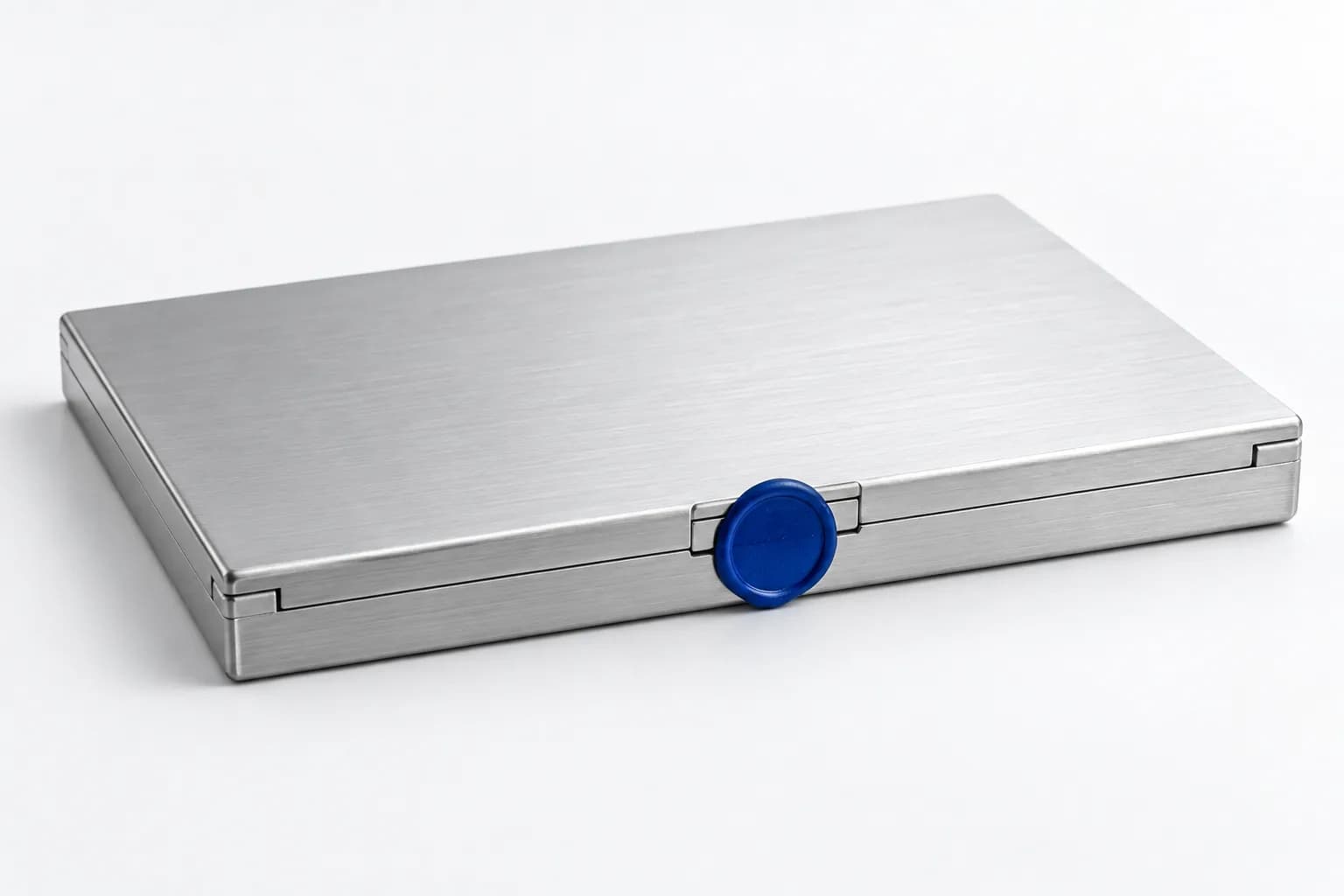
A closed brushed aluminium document case lying flat on a pale surface, sealed with a deep cobalt blue wax seal pressed into its closure.
An export is closed and sealed in the sense that matters: what is inside it can be checked by the person who receives it, without asking the sender anything.
# one value, as exported. fictional record.

record        halden-therapeutics-ag
property      development_phase
value         Phase 2
status        cited

excerpt       “This open-label Phase 2 study of HLD-204 in
              previously treated metastatic pancreatic
              adenocarcinoma is currently recruiting.”
source        ClinicalTrials.gov NCT06712233, record version 9
locator       clinicaltrials.gov/study/NCT06712233
observed      11 March 2026
entered       11 March 2026

chosen_over   Phase 1/2
              Company press release, 14 January 2026
              ground: the registry record outranks a press
              release about that registry record

reader        Research analyst, public-sources clearance
as_of         14 March 2026

# the same record also exports its negatives

property      phase_2_readout_date
status        not_found
reason        no source held states a readout date; the
              registry estimate is a different quantity
searched      4 sources, 11-13 March 2026, each with
              the date and what it returned
An export is a set of properties about one value, not a row from a table. Every field above is checkable by the person receiving it: the excerpt against the retained document, the locator against the source, the dates against each other.

what each field lets an auditor check

property, value, status
What was asserted, and whether it is an assertion at all. Status is one of cited, not found, blocked or not applicable, and there is no fifth state in which a value simply appears.
excerpt, source, locator
The sentence the value was read from, word for word, the document it sits in and the page or address inside that document. A paraphrase in this field is a defect, not a shorter citation.
observed, entered
The day the source was read, and the day the value entered the record. Two dates, because a value read in March and filed in April is not the same object as a value read in April.
chosen_over
The competing values that were on the record when this one was carried, each with its own source and the stated ground for not carrying it. An export with no disagreement in it says so explicitly rather than by omission.
reader, record
Who the export was produced for, under which clearance, and the identifier of the record it came from. The identifier survives every rename of the thing it names, so a file opened in three years still resolves.

What the export does not claim: that the source is true. The guarantee is that you are reading what the source said, where it said it, on the date it was read, and what it was carried over. Whether ClinicalTrials.gov is right about the phase is a question about ClinicalTrials.gov, and the export gives you everything you need to take that question up with them.

References

References

Standards and papers behind the properties described on this page: provenance models, the closed-world convention, temporal databases and the definition of audit evidence.

  1. [1]

    PROV-DM: The PROV Data Model

    Luc Moreau and Paolo Missier, editors

    W3C Recommendation, 30 April 2013. https://www.w3.org/TR/prov-dm/

  2. [2]

    Why and Where: A Characterization of Data Provenance

    Peter Buneman, Sanjeev Khanna and Wang-Chiew Tan

    International Conference on Database Theory (ICDT), 2001. https://doi.org/10.1007/3-540-44503-X_20

  3. [3]

    On Closed World Data Bases

    Raymond Reiter

    In Logic and Data Bases, Plenum Press, 1978, pages 55-76. https://doi.org/10.1007/978-1-4684-3384-5_3

  4. [4]
  5. [5]

    Temporal Features in SQL:2011

    Krishna Kulkarni and Jan-Eike Michels

    ACM SIGMOD Record 41(3), 2012. https://doi.org/10.1145/2380776.2380786

  6. [6]

    AS 1105: Audit Evidence

    Public Company Accounting Oversight Board

    PCAOB auditing standard. https://pcaobus.org/oversight/standards/auditing-standards/details/AS1105

Further reading

Articles on this page’s subject.

The research library

Bring one entity you already argue about internally.

A supplier two teams describe differently, a counterparty whose name changed, a program whose phase nobody can cite. We will show you what it looks like when every value on it carries the sentence it came from and every absence on it is a statement somebody dated.